
Risk Map
Why Classical Risk Mapping Was Useful, but Is No Longer Enough
Problem Statement
The traditional Risk Map is one of the most familiar tools in management.
Most organizations know it well. Risks are plotted on two axes: likelihood and impact. The result is a simple visual grid, often color-coded from green to yellow to red. It is intuitive, easy to communicate, and helpful for governance, prioritization, and executive discussion.
And that is exactly why the Risk Map has survived for so long.
It gives leaders a shared language. It creates visibility. It supports accountability. It helps organizations compare exposures across business units, regions, portfolios, or functions.
But the world in which the Risk Map became useful is no longer the world in which most organizations now operate.
Today, the most important developments do not always arrive as clearly visible risks. They often begin earlier:
as weak signals,
as subtle tensions,
as structural drift,
as shifting expectations,
as the first Genesis Points of a larger transformation.
he central question is therefore no longer only:
How large is this risk?
It is increasingly:
How early can we recognize the signal, how much time do we still have, and can we still shape the outcome before it hardens into a problem?
That is where the classical Risk Map begins to show its limits.
Executive Summary
The Risk Map is not wrong. It is useful. It remains a valuable tool for visibility, prioritization, governance, and communication.
But it is incomplete.
It answers the question:
How serious does this risk appear once it is already visible?
It answers that well.
What it does not answer sufficiently is the more strategic question:
How early did we recognize the development, and how much room do we still have to influence it?
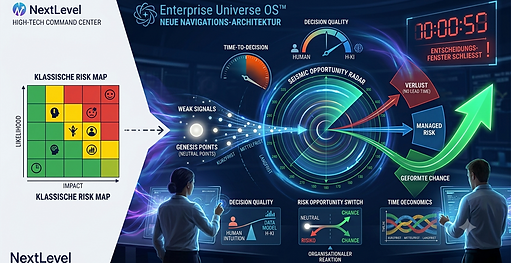
Within the Enterprise Universe OS™, the Risk Map is therefore not rejected. It is transcended.
Its logic is expanded through a more dynamic way of thinking, centered on:
Genesis Points, because every important development begins as a neutral signal,
Seismic Opportunity Radar, because early tension must be detected before it hardens,
Time-to-Decision, because the real currency of strategic action is the time that remains,
Decision Quality, because a signal only matters if it is interpreted correctly,
Risk Opportunity Switch, because the same signal can become either risk or opportunity depending on response,
Time Oeconomics, because value itself is fundamentally time-dependent.
The classical Risk Map remains useful.
But it is no longer enough on its own.
What the Risk Map Does Well
Before questioning the Risk Map, it is important to acknowledge its strengths.
A good Risk Map helps organizations:
classify a large number of risks,
distinguish urgent from less urgent issues,
compare exposure across functions and business units,
create shared visibility,
structure governance,
and support board-level discussion.
That matters.
For many organizations, especially in more stable environments, the Risk Map is a very practical first step. It reduces complexity. It creates clarity. It gives decision-makers a common frame of reference.
In that sense, the classical Risk Map is not obsolete.
It is simply not the final answer.
Key Insight
The Risk Map is useful for visibility. It is not sufficient for strategic navigation.
The Fundamental Limitation of the Risk Map
The core limitation of the Risk Map is subtle but important:
It often treats risk as if it were already a finished object.
A signal is identified, rated, color-coded, documented, and placed into a governance process.
That creates order.But it also creates a dangerous impression:
as if the risk already exists in fully formed shape.
In reality, many of the most important developments do not become risks first.
They begin as neutral Genesis Points.
That is a crucial difference.
A Genesis Point is not yet:
a risk,
an opportunity,
a disruption,
a threat,
or a forecast.
It is simply an early structural signal that reality is beginning to change.
The classic Risk Map usually begins where the signal has already become visible enough to classify.
The modern strategic challenge begins earlier.
Key Insight
The Risk Map classifies visible risk. The Enterprise Universe logic begins with early emergence.
Why the Risk Map Still Feels So Familiar
The Risk Map remains popular because it is psychologically comfortable.
It gives a feeling of order. It gives a feeling of overview. It gives the impression that uncertainty has been made manageable.
That is one reason why the model continues to be so widely used.
And in many contexts that is still valuable.
But in structurally uncertain environments, that same comfort can become a trap.
A clean matrix may suggest that the organization has understood reality when in fact it has only classified one visible expression of it.
That is the subtle danger:
visibility can easily be mistaken for capability.
Key Insight
A risk that is visible is not the same thing as a risk that is still shapeable.
Why the Modern World Requires a Different Logic
In a world shaped by:
technological acceleration,
geopolitical volatility,
climate pressure,
social transformation,
cyber asymmetries,
regulatory acceleration,
and constantly shifting market expectations,
the decisive question is no longer just how large a risk might become.
The decisive question is also:
How much time do we still have to influence the development before it freezes into a real constraint?
The Risk Map primarily asks:
How likely is the event?
How severe could the loss be?
Those are important questions.
But they are no longer the whole picture.
The strategic question of today is often:
Can we still shape the outcome before the window closes?
That is the core shift.
Genesis Points: The Beginning of Strategic Reality
This is where the Seismic logic begins.
The modern view starts not with a finished risk, but with a Genesis Point.
A Genesis Point is a neutral early signal indicating that something is beginning to change.
At this stage, the future is still open.The signal is not yet a threat. It is not yet an opportunity. It is not yet a risk.
It is only the beginning of a shift.
And that is what makes it so valuable.
Because at the beginning of a development, organizations typically still possess the greatest amount of freedom:
freedom to observe,
freedom to test,
freedom to prepare,
freedom to learn,
freedom to build capability,
freedom to shape the next steps.
As time passes, that freedom declines.
The same development becomes more rigid. The same signal becomes harder to influence. The same future becomes increasingly fixed.
Key Insight
Genesis Points do not give finished answers. They give organizations the earliest possible access to future choice.
Genesis Points Are Always Neutral
One of the foundational principles of the Enterprise Universe OS™ is simple:
A Genesis Point is always neutral.
It is not a risk. It is not an opportunity. It is not a threat. It is not a forecast.
It is simply a structural indication that reality is shifting.
Whether the development later becomes a risk or an opportunity depends on what happens next:
how early it is detected,
how accurately it is interpreted,
how much time remains,
and whether the organization is able to act.
This is an important shift in thinking.
The signal itself carries no fixed polarity.
The organization assigns meaning through its response.
Key Insight
A Genesis Point is always neutral. Risk and opportunity do not live inside the signal. They emerge through perception, interpretation, timing, and action.
Why the Same Signal Can Become Risk or Opportunity
This is the point where the classical Risk Map and the Seismic Opportunity Radar diverge most strongly.
Traditional risk thinking often implies that a signal already belongs in one category:
risk,
or opportunity.
The modern view is different.
The same neutral Genesis Point can lead to completely different outcomes depending on:
when it is recognized,
how it is interpreted,
whether the organization has enough time to act,
and whether it has the capability to respond meaningfully.
A company that sees a signal early may use it to build new capabilities, stronger positioning, or more resilient structures.
A company that sees the same signal late may experience that same development as a cost shock, compliance burden, or strategic disadvantage.
The signal was the same.The response was different.
Key Insight
The signal is neutral.The organizational response determines whether it becomes a risk or an opportunity.
The Risk Map as a Late-Stage Tool
That is one of the reasons the classic Risk Map is limited.
It is often strongest once the signal is already sufficiently visible to classify.
That makes it a late-stage tool.
It is good at telling us:
how severe something appears,
how much exposure exists,
and where attention is needed now.
It is less strong at telling us:
where the development began,
whether it can still be shaped,
how much time remains,
or whether the organization still has enough freedom to convert the signal into value.
That is a strategic distinction.
Key Insight
The Risk Map often tells us what has become visible. The Seismic logic asks what is beginning to emerge.
Why the Seismic Opportunity Radar Changes the Logic
The Seismic Opportunity Radar does not replace the Risk Map by rejecting its usefulness.
It changes the deeper logic.
Instead of beginning with a visible risk, it begins with early tension.
Instead of asking only how likely a loss is, it asks whether the organization still has enough time, freedom, and capability to shape the development before it becomes irreversible.
That is a very different way of thinking.
It is not just a better way to classify risk. It is a better way to navigate reality.
Key Insight
The Risk Map helps organizations classify exposure. The Seismic Opportunity Radar helps them navigate emerging reality.
Why Seismic Matters More Than the Risk Map in Volatile Environments
The Seismic Opportunity Radar is built for a world in which early signals matter more than late event classification.
It helps organizations detect weak signals before they become visible on a conventional risk matrix.
That means leaders can:
prepare earlier,
test alternatives sooner,
build capabilities before pressure peaks,
position themselves before the market moves,
and preserve strategic freedom while there is still time.
This changes the leadership conversation.
Instead of asking only:
How serious is the risk?
the organization also asks:
How much time do we still have to influence the outcome?
That is the logic of Seismic.
Key Insight
Seismic does not merely detect change. It gives organizations more time to shape it.
Why Time-to-Decision Is the Real Currency
The classic Risk Map asks about probability and impact.
The Seismic Opportunity Radar introduces a more strategic currency:
Time-to-Decision.
Time-to-Decision describes how long a decision remains effective, reversible, or value-creating before the development becomes irreversible.
That changes everything.
Because a large risk with enough time still available may be manageable.A moderate risk with almost no time left may already be existential.
The issue is therefore not only the size of the risk. It is also the remaining time to act.
Key Insight
Probability tells you what might happen. Time-to-Decision tells you whether you still have the freedom to influence what happens.
Why Decision Quality Is Essential
Even an early signal is not enough.
A signal only becomes strategically useful if the organization interprets it correctly.
This is why Decision Quality is one of the central bridges in the modern logic.
Decision Quality asks:
Do we understand what we are seeing?
Are we interpreting the signal correctly?
Are we acting on the real situation, or on outdated assumptions?
Do we recognize the meaning of the signal before it hardens into a problem?
A company can detect a signal early and still respond badly. It can classify a risk correctly and still make the wrong move. It can have formal governance and still remain strategically blind.
Key Insight
Signal detection is not enough. The quality of interpretation determines the quality of the outcome.
Why the Risk Map Can Create an Illusion of Strategy
One of the biggest hidden problems with the classical Risk Map is psychological.
A neatly populated matrix can create the impression that the organization has already managed uncertainty simply because it has visualized it.
That is where the illusion of control begins.
The map is complete.The colors are set.The governance is informed.And still the organization may be reacting too late.
That is the strategic blind spot:
documentation is not navigation.
Key Insight
A risk map can make an organization feel informed even when it is still strategically late.
The Role of AI in the New Risk Logic
The emergence of Artificial Intelligence does not invalidate the classical Risk Map.
It does, however, change what organizations are capable of seeing.
Traditional Risk Maps were developed in a world where leaders, analysts, risk managers, and governance functions had to identify, assess, and prioritize emerging developments largely through human observation and periodic review processes. That approach remains valuable.
In fact, many organizations will begin their journey toward more advanced signal detection through disciplined human observation, structured governance practices, and systematic environmental scanning.
However, as complexity increases, so does the challenge of maintaining awareness across thousands of possible signals, stakeholders, technologies, regulatory developments, and market shifts.
This is where Artificial Intelligence becomes a powerful accelerator.
AI can help organizations:
identify weak signals at scale,
discover emerging patterns,
detect connections across seemingly unrelated developments,
monitor Genesis Points continuously,
and surface developments long before they become visible on a traditional Risk Map.
Importantly, AI does not replace leadership.
AI can increase the speed and breadth of perception.
But perception alone is not enough.
Organizations still need people to:
interpret significance,
evaluate context,
assess strategic relevance,
make decisions,
and take responsibility for action.
The goal is therefore not automation for its own sake.
The goal is to improve the organization's ability to recognize emerging reality while meaningful options still exist.
As organizations mature, they may evolve from:
human observation,
to structured signal management,
to AI-assisted analysis,
and eventually to autonomous monitoring and continuous calibration.
The Seismic Opportunity Radar supports this entire maturity journey.
It can be used by organizations that rely primarily on human expertise today, as well as by organizations that use AI and autonomous agents to expand their sensing capabilities.
Key Insight
The Risk Map was designed to classify visible risks.
The Seismic Opportunity Radar was designed to detect emerging tension before it becomes visible risk.
Organizations may begin this process through disciplined human observation and progressively enhance it through analytics, artificial intelligence, and autonomous agents as their maturity increases.
Practical Example: New Regulation
Imagine a new regulation begins appearing in draft form.
The classical Risk Map may eventually mark it as:
high likelihood,
high impact.
That is useful.
But the more strategic question is:
Is this still just a regulation risk? Or is it still a neutral Genesis Point from which the company can build a stronger future position?
Company A sees the development late. The organization moves through approvals, governance reviews, and formal processing. By the time action begins, the regulation is already mandatory.
The consequence:
compliance pressure,
cost increase,
operational rework,
and limited flexibility.
Company B sees the same development early. It uses the time to redesign processes, build supplier readiness, inform customers, and position itself strategically.
The regulation is the same. The outcome is not.
Key Insight
A signal is not good or bad by itself. What matters is whether the organization still has enough time to shape it.
Practical Example: New Technology
A new technology emerges.
The classical Risk Map may classify it as a competitive threat.
That is understandable.
But in a Seismic logic, the question is not only whether it is threatening.
It is also:
Is it still early?
Is there still time to test and learn?
Can we still build capabilities before the market matures?
Can we use the signal to create strategic options rather than just defend against it?
Companies that answer those questions well often turn what first looked like risk into a source of future advantage.
Key Insight
The earliest stage of a signal is often the stage with the most strategic freedom.
Why the Risk Map Is Not Wrong, but the World Has Moved On
This is the fairest final judgment.
The classic Risk Map is not a bad tool.
It still works well for:
governance,
reporting,
prioritization,
communication,
and visibility.
But the world has moved on.
The organizations that will succeed are not only the ones that classify risks well.
They are the ones that:
detect early tension,
understand it accurately,
use the remaining time wisely,
and convert uncertainty into strategic advantage before it becomes irreversible.
That is what the Seismic Opportunity Radar adds.
Key Insight
The Risk Map tells you how serious something is. The Seismic Opportunity Radar tells you whether the future is still shapeable.
NextLevel Statement
The classical Risk Map remains a useful tool for visibility, prioritization, and governance.
But in a world of structural uncertainty, it is no longer enough on its own.
The Seismic Opportunity Radar extends the logic of risk management by introducing the dimensions that increasingly determine strategic success:
early tension detection,
Time-to-Decision,
Decision Quality,
strategic freedom,
and the ability to convert neutral Genesis Points into value before they harden into constraints.
The future does not arrive labeled as a risk or an opportunity.
It arrives first as a neutral signal.
And the organizations that understand this earliest are the ones that create the future instead of merely reacting to it.
FAQ
What is the classical Risk Map?
The classical Risk Map is a management tool that classifies risks on the dimensions of likelihood and impact. It helps organizations prioritize and communicate risks clearly.
Why is the classic Risk Map not enough anymore?
Because it often sees only the late, visible form of a development and not the early tension from which risks and opportunities emerge.
Is the Risk Map wrong?
No. It is useful and still relevant. But in a world of structural uncertainty, it is incomplete on its own.
What is the biggest limitation of the Risk Map?
It often classifies visible risks well, but it does not sufficiently address early signal detection, Time-to-Decision, or strategic optionality.
What is a Genesis Point?
A Genesis Point is a neutral early signal that indicates reality is beginning to change. It is not yet a risk or an opportunity.
Why is the Seismic Opportunity Radar important?
Because it helps organizations detect early tensions while they are still shapeable, thus preserving more future freedom.
How does Time-to-Decision fit into this?
Time-to-Decision measures how long an organization can still act effectively before a development becomes irreversible.
Why is Decision Quality relevant?
Because even early signals are useless if they are misinterpreted. Decision Quality determines whether the organization reads reality correctly.
How does AI change the logic?
AI can detect weak signals and early patterns at speed, while human leadership ensures meaning, priority, and strategic judgment.
What is the main message of the Seismic Opportunity Radar?
That organizations should not only classify risks after they become visible, but also recognize early tensions while there is still time to shape the future.
Why do organizations often get surprised by risks they were already monitoring?
Because monitoring is not the same as understanding.
Many organizations can point to reports, dashboards, or Risk Maps showing that a risk was technically visible. Yet the signal was not interpreted with sufficient urgency, context, or strategic relevance.
The problem is often not a lack of information.
The problem is a lack of Decision Quality and an overreliance on classification instead of continuous interpretation.
Why do traditional Risk Maps struggle with disruptive innovation?
Because disruptive innovation rarely appears first as a visible risk.
Most disruptive developments begin as weak signals, small experiments, emerging technologies, changing customer behavior, or seemingly insignificant market shifts.
By the time the disruption appears as a major risk on a Risk Map, much of the available Time-to-Decision may already be gone.
Can a company have excellent risk management and still fail?
Yes.
Many organizations have mature governance structures, detailed risk reporting, and well-maintained Risk Maps.
Yet they still fail because they recognize structural change too late.
Managing known risks well is not the same as recognizing emerging reality early enough.
The most dangerous threats often do not come from known risks.
They come from developments that were not recognized in time.
Why do boards and executive teams often discuss the wrong risks?
Because visible risks naturally attract attention.
They are easier to quantify, explain, report, and govern.
However, the most strategically important discussions often concern developments that are not yet fully visible.
This creates a leadership challenge:
Organizations spend significant time discussing known risks while potentially overlooking the early signals that will shape future risks.
How does the Seismic Opportunity Radar reduce strategic blind spots?
The Seismic Opportunity Radar focuses on emerging tension rather than only visible exposure.
Instead of asking:
"Which risks are already material?"
it also asks:
"Which developments are beginning to emerge?"
This helps organizations identify Genesis Points earlier, expand their Time-to-Decision, and preserve greater strategic freedom before the situation becomes constrained.
What is the biggest mistake organizations make when using a Risk Map?
The biggest mistake is assuming that visibility equals control.
A Risk Map can provide valuable transparency.
It cannot guarantee that an organization:
understands the signal correctly,
acts in time,
preserves strategic optionality,
or maintains enough freedom to shape the outcome.
A visible risk may still become a major failure if the organization reacts too late.
Why do organizations often get surprised by things that were technically already visible?
Because visibility and understanding are not the same thing.
Many post-crisis reviews reveal that the signal was already present somewhere in the organization.
The real failure was not detection.
It was interpretation, prioritization, and action.
The challenge is therefore not only to see reality.
It is to recognize its importance while meaningful options still exist.
Related Topics
Seismic Opportunity Radar
Risk Opportunity Switch
Time-to-Decision
Decision Quality
Time Oeconomics
Value Density
Enterprise Risk Management (ERM)
Value at Risk (VaR)
Expected Shortfall (CVaR)
Adaptive Governance