
Customer-Holder Governance - Why Modern Governance Must Create Value, Not Just Manage Power
Problem Statement
Most organizations do not suffer from a lack of governance.
They suffer from governance that is disconnected from value.
Projects are approved.Budgets are allocated.Committees are formed.Stakeholders are managed.Reports are produced.
And yet executives continue to ask the same questions:
Why do we have so many initiatives but so little impact?
Why do transformation programs create activity without adaptation?
Why are investments approved when customer value remains unclear?
Why does internal alignment often seem more important than market relevance?
Why do organizations become more complex while customers experience little improvement?
These questions point to a deeper issue.
Many governance systems are designed to manage power, influence, accountability, and risk. They are not necessarily designed to create value.
That is where Customer-Holder Governance begins.
It introduces a second dimension that is largely absent from traditional governance models: value creation.
Traditional governance asks:
Who has authority?
Customer-Holder Governance asks:
Who receives value?
Traditional governance asks:
Who can approve?
Customer-Holder Governance asks:
Why should this initiative exist in the first place?
Traditional governance manages influence.
Customer-Holder Governance governs value.
Executive Summary
Customer-Holder Governance is a modern governance logic for projects, initiatives, investments, transformations, and strategic decisions.
It is built on a simple observation:
Power and value are not the same thing.
Many organizations are highly effective at identifying decision-makers, sponsors, executives, steering committees, budget owners, and regulatory stakeholders.
Far fewer organizations are equally effective at identifying the actual recipients of value.
As a result, projects frequently become:
politically aligned but strategically weak,
well-governed but poorly prioritized,
highly visible but low impact,
operationally successful but economically irrelevant.
Customer-Holder Governance solves this problem by integrating two perspectives:
Stakeholders
People or groups with power, influence, authority, or the ability to affect outcomes.
Customer-Holders
People, groups, or systems that ultimately receive, experience, benefit from, or legitimize the value created.
Governance is no longer limited to asking who should approve a decision.
It begins asking:
Does this decision create meaningful value for the people or systems it is supposed to serve?
That shift fundamentally changes how organizations prioritize projects, allocate resources, evaluate investments, and create long-term relevance.
Why Traditional Governance Often Falls Short
Traditional governance frameworks emerged in a world where control was often the primary challenge.
Organizations needed:
accountability,
reporting structures,
escalation paths,
approval mechanisms,
risk controls,
formal authority.
Those capabilities remain important.
But modern organizations face a different challenge.
The challenge is no longer simply:
How do we control complexity?
It is increasingly:
How do we create meaningful value in a complex world?
The problem is that many governance systems still operate according to assumptions designed for stability.
They focus on:
ownership,
compliance,
reporting,
hierarchy,
authorization.
All of these matter.
But they do not necessarily answer the question every executive should be asking:
Why should this initiative exist at all?
Why Projects Often Consume Resources Without Creating Value
Most companies do not lack projects.
They lack clarity about which projects create value.
Think about how many initiatives are launched every year:
transformation programs,
digitalization efforts,
AI projects,
customer experience initiatives,
organizational redesigns,
ESG investments,
innovation portfolios.
Many receive funding.Many receive executive attention.Many receive governance oversight.
Yet surprisingly few organizations consistently ask:
Which Customer-Holders will experience measurable value if this initiative succeeds?
This creates a dangerous pattern.
Projects survive because they have sponsors.
Projects survive because they fit political interests.
Projects survive because budgets already exist.
Projects survive because they are difficult to cancel.
Meanwhile, the actual value logic remains unclear.
Key Insight
Projects rarely fail because they lack governance.They often fail because governance never clarified the value they were supposed to create.
Why the Mendelow Matrix Is Not Enough
For decades, organizations have relied on frameworks such as the Mendelow Matrix, the Power-Interest Grid, and various stakeholder mapping approaches.
These models remain useful.
They help leaders understand:
influence,
dependencies,
communication priorities,
approval paths,
stakeholder dynamics.
But they leave one critically important question unanswered:
Who actually creates or receives value?
The Mendelow Matrix is designed to classify stakeholders according to:
power,
interest.
Customer-Holder Governance adds a third dimension:
value.
This distinction matters because power can approve a project.
Power can delay a project.
Power can block a project.
Power can accelerate a project.
But power alone does not determine whether the project creates meaningful value.
That is where Customer-Holder Governance begins.
Key Insight
Traditional stakeholder models help manage influence.Customer-Holder Governance helps govern value creation.
The Difference Between Power and Value
This distinction sits at the center of the entire framework.
A stakeholder may possess significant authority without directly defining value.
Another individual or group may possess very little formal authority while being essential to value creation.
Example
A board member may approve a large digital transformation initiative.
They possess authority.
They possess power.
They possess approval rights.
But the business value of that initiative will ultimately be determined elsewhere:
by customers,
by users,
by market adoption,
by real-world outcomes,
by measurable improvements.
The board can authorize value creation.
It cannot declare value into existence.
That power belongs to the market.
Key Insight
Authority decides what can happen.Value determines what actually matters.
This is exactly why Customer-Holder Governance separates power structures from value structures.
Both are important.
Neither should be confused with the other.
Customer-Holders: The Missing Reference Point
The Customer-Holder concept introduces the missing reference point in governance.
Customer-Holders are not defined by authority.
They are defined by value.
They are the people, groups, or systems that experience the consequences of success or failure.
Examples may include:
customers,
users,
communities,
suppliers,
society,
the environment,
future generations,
internal customer groups,
ecosystem partners.
The important question is not:
How much power do they have?
The important question is:
How much value is created or destroyed through the decisions we make?
Key Insight
Stakeholders influence decisions.Customer-Holders justify decisions.
Why Customer-Holder Governance Matters for CEOs
Many CEOs face a familiar frustration.
The organization is busy.
The portfolio is full.
The governance structures are functioning.
The committees meet.
The projects advance.
Yet growth remains disappointing.
Transformation remains slow.
Customer impact remains unclear.
Why?
Because organizations often optimize governance around political alignment instead of value creation.
Customer-Holder Governance forces leadership teams to ask harder questions:
Which initiatives create meaningful customer value?
Which projects merely create internal activity?
Which investments strengthen future relevance?
Which decisions make the enterprise more valuable to the market?
CEO Question
The most important governance question is often not:
Who supports this initiative?
But rather:
Which Customer-Holders will be materially better off because this initiative exists?
Why Customer-Holder Governance Matters for CFOs
For CFOs, the framework becomes even more practical.
Most investments already have:
financial projections,
ROI calculations,
business cases,
governance reviews.
Yet many organizations still struggle with one basic issue:
Are we funding activity or value?
This is where Customer-Holder Governance becomes powerful.
It helps finance leaders distinguish between:
investments that improve reporting,
investments that improve control,
investments that improve efficiency,
and investments that create durable value.
CFO Perspective
Customer-Holder Governance helps answer:
Which investments create lasting customer value?
Where does strategic relevance increase?
Which initiatives generate future optionality?
Which projects improve actual value creation capability?
It moves governance beyond budget control and toward value stewardship.
Why Customer-Holder Governance Matters for Mitunternehmen (Internal Co-Entrepreneurs)
At NextLevel, we deliberately use the German term Mitunternehmen.
The word reflects a different view of people inside the organization.
Traditional governance often sees employees as recipients of instructions.
Customer-Holder Governance sees Mitunternehmen as active contributors to value creation.
They are not simply there to execute decisions.
They are there to help create outcomes.
That changes governance significantly.
Good governance is no longer about controlling behavior.
It is about creating the conditions required for value creation.
That means:
clarity,
trust,
responsibility,
transparency,
learning,
decision capability.
Key Insight
Mitunternehmen do not merely execute value creation.They help create it.
This perspective aligns naturally with Quasar, Resonance Spaces, and the broader NextLevel philosophy of adaptive enterprise design.
Why Learning Matters More Than Justification
Many governance systems end projects the same way:
A report is produced.
A closure meeting takes place.
A status review is completed.
The project is formally finished.
Customer-Holder Governance follows a different logic.
The most important question is not:
Who was right?
The most important question is:
What did we learn?
Learning creates future value.
Justification does not.
This simple shift changes governance from a control mechanism into an adaptive capability.
Key Insight
Projects should not end in justification.Projects should end in learning.
That is one of the deepest connections between Customer-Holder Governance and Time Economics.
Value is not only created through action.
Value is also created through learning.
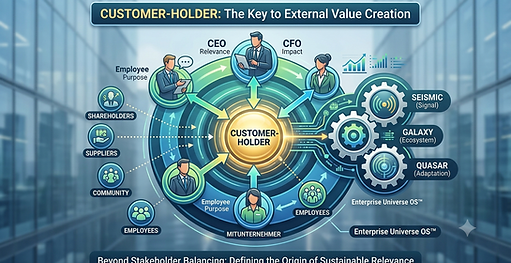
How Customer-Holder Governance Connects the Enterprise Universe OS™
Customer-Holder Governance is not a standalone model.
It acts as the leadership layer connecting the entire Enterprise Universe OS™.
Seismic Opportunity Radar
Identifies emerging signals, opportunities, risks, and shifts in the external environment.
Galaxy OS
Maps how those signals propagate across customers, suppliers, regulators, investors, and ecosystems.
Quasar OS
Creates the internal capability, permission, and adaptability required to respond.
Customer-Holder Governance
Ensures that priorities, investments, initiatives, and decisions are aligned with actual value creation.
Key Insight
Seismic detects. Galaxy contextualizes.Quasar enables.Customer-Holder Governance prioritizes value.
Why Customer-Holder Governance Belongs to a Next-Generation Enterprise Logic
Traditional business administration often focused heavily on internal efficiency, rigid structures, and top-down control.
The Next-Generation Enterprise Logic shifts the focus toward market dynamics, real-world impact, and organizational adaptability.
It asks a much more fundamental set of questions:
Where does sustainable value actually originate?
How does an enterprise remain genuinely relevant to the market?
What kind of enterprise ecosystem is required to create and sustain enduring customer value?
How must strategy, leadership, finance, innovation, and governance evolve to support this reality?
Customer-Holder Governance is therefore much more than a governance framework.
It represents a structural shift in how enterprises understand decision-making itself.
The Shift
From Internal Optimization→ To External Relevance
From Managing Competing Interests→ To Co-Creating Value
From Power Administration→ To Value Governance
From Rigid Control→ To Meaningful Adaptability
That is the essence of a Next-Generation Enterprise Logic.
Future Perspective
The future will not reward organizations simply because they are well governed.
It will reward organizations that govern value better than others.
As complexity increases:
more data,
more technology,
more projects,
more stakeholders,
more decisions,
the ability to distinguish power from value becomes increasingly important.
Customer-Holder Governance creates that distinction.
And once organizations begin governing value rather than merely managing influence, they gain something remarkably powerful:
clarity,
focus,
priority,
adaptability,
and sustainable relevance.
Alternative Language Perspective
This concept is also available in an alternative language perspective under the term Custom-Holder Governance.
While the English version uses Customer-Holder Governance to emphasize the customer as the primary holder of external value creation, the alternative language version uses Custom-Holder Governance as part of the proprietary NextLevel vocabulary.
Both articles describe the same governance philosophy: governance should not merely manage authority, control, and decision rights, but should actively align enterprise leadership, investments, and strategic priorities with sustainable customer value creation.
The two articles complement each other and can be read as different language perspectives on the same underlying concept.
Read the alternative language perspective: Custom-Holder Governance
NextLevel Statement
Most governance systems are designed to manage power.
Customer-Holder Governance is designed to create value.
It separates influence from relevance, authority from impact, and governance from bureaucracy.
By making Customer-Holders the central reference point for projects, investments, and strategic decisions, organizations move beyond stakeholder administration toward true value governance.
Because the most important governance question is not:
Who has the most power?
The most important governance question is:
Who receives the value — and how can we create more of it?
That is the foundation of modern enterprise leadership.
Customer-Holder Governance – Executive FAQ
1. Why do so many organizations have too many projects and too little impact?
Because projects are often approved based on influence, urgency, political visibility, or available budgets rather than actual value creation.
Customer-Holder Governance introduces a different question:
Which projects create the greatest value for those who ultimately experience the outcome?
Without that filter, portfolios tend to grow faster than their impact.
2. Why do executives often struggle to stop projects?
Because governance systems are frequently designed to approve initiatives but not to continuously challenge their value assumptions.
Once money, sponsorship, and prestige are involved, projects can become politically difficult to stop.
Customer-Holder Governance asks:
Is this initiative still creating meaningful value for its intended Customer-Holders?
If not, stopping may be the most responsible decision.
3. Why do companies keep investing in projects without clear customer benefits?
Because benefits are often defined internally rather than externally.
Organizations can measure implementation, activity, and compliance very precisely while struggling to measure actual customer value.
Customer-Holder Governance shifts the focus from internal completion to external outcomes.
4. Why do stakeholder meetings sometimes feel political rather than productive?
Because many meetings become negotiations between competing interests rather than discussions about value creation.
Participants defend functions, budgets, responsibilities, and priorities.
Customer-Holder Governance introduces a common reference point:
Which option creates the greatest sustainable value?
That often changes the entire conversation.
5. How can CEOs identify initiatives that truly matter?
A simple question helps:
Which Customer-Holders will clearly benefit if this initiative succeeds?
If leadership cannot answer that question, the project may be consuming resources without creating sufficient value.
6. Why do transformation programs often generate activity but little change?
Because organizations frequently measure implementation rather than outcomes.
Projects are launched.
Systems are deployed.
Training is completed.
Governance milestones are achieved.
Yet real value creation remains unchanged.
Customer-Holder Governance focuses on outcomes rather than activity.
7. Why do customers often disappear from governance discussions?
Because governance conversations frequently revolve around risk, authority, reporting, and budgets.
The customer becomes an abstract concept instead of a concrete decision criterion.
Customer-Holder Governance intentionally puts customer value back into the center of decision-making.
8. Why does internal alignment sometimes reduce innovation?
Because alignment can become a goal in itself.
When every stakeholder must fully agree before anything moves forward, organizations often optimize for consensus instead of relevance.
Customer-Holder Governance asks whether alignment is creating value or simply preserving comfort.
9. Why do some projects look successful internally but fail in the market?
Because internal success measures and market success measures are not always the same.
A project can be delivered on time, on budget, and according to specification while creating little value for customers.
Customer-Holder Governance helps close that gap.
10. What is the biggest mistake organizations make when prioritizing investments?
Many organizations ask:
Who supports this investment?
before asking:
Who benefits from this investment?
The first question manages power.
The second manages value.
Long-term success depends on the second.
11. Why do employees sometimes feel disconnected from strategy?
Because strategy is often communicated in terms of goals, targets, projects, and metrics.
People rarely see how those elements connect to meaningful value creation.
Customer-Holder Governance creates that connection by making value recipients visible.
12. Why do organizations struggle with decision-making speed?
Because too many decisions travel through layers of approval without a clear value reference.
When every stakeholder has a voice but nobody owns value creation, decisions become slower and more complex.
Customer-Holder Governance introduces a common decision logic: value first.
13. How does Customer-Holder Governance improve resource allocation?
It helps organizations allocate time, talent, attention, and capital according to expected value creation rather than political visibility.
Resources become investments in value rather than expenses driven by influence.
14. Why do many governance models fail in highly dynamic environments?
Because they were designed primarily for control and predictability.
Modern organizations operate in environments shaped by uncertainty, technology shifts, market volatility, and changing customer expectations.
Customer-Holder Governance combines governance with adaptability by keeping value creation as the primary reference point.
15. How can leadership determine whether governance is adding value or creating bureaucracy?
A useful test is:
Does governance help us create better decisions and more value, or does it mainly create additional approval layers?
When governance primarily adds complexity without improving outcomes, it has become administrative rather than strategic.
Customer-Holder Governance exists to prevent exactly that.
16. What is the most important governance question an organization can ask?
Not:
Who owns this project?
Not:
Who approved the budget?
Not:
Who is accountable?
But:
Who will experience more value because this initiative exists?
Because once that question is answered clearly, priorities, investments, decisions, governance structures, and strategic choices become dramatically easier to evaluate.
Related Topics
Customer-Holder
Seismic Opportunity Radar
Galaxy OS
Quasar OS
Resonance Spaces
Mendelow Matrix
Quasar Impact-Flow Matrix